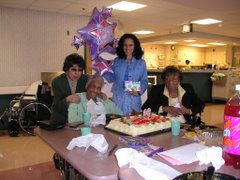
I just realized I came here last March 12-17-----also for Dad's birthday. He will turn 96 on Sunday.
BTW, It was 76F when I left Miami and 19F when I landed in Chicago.
Thursday, March 12, 2009


Wednesday, March 11, 2009
Annual Caregiver Conference-Today, I Attended My 4th in Three Years
I found today's caregiver conference as helpful as they always are. I am re-posting what I wrote two years ago. The learning is as relevent now.
Blog caregiver conference repost
May 24, 2007
Gathering Information At the Fearless Caregiver Conference
I am feeling invigorated and empowered after attending the ninth annual Fearless Caregiver Conference, held yesterday in Ft Lauderdale. Two months ago I attended this conference when it was held in Miami.
At both conferences, I benefited significantly from the opportunity to learn from professionals in all aspects of elder care who presented products and services and shared their wisdom about caregiving. I was also able to connect with other caregivers who have dedicated a significant part of their lives toward caring for their aging loved ones. While I learned a lot, I realized how much I've already learned as a result of being a solo long-distance caregiver for more than two years now. During the question and answer sessions, I realized I could have contributed some wisdom to every single discussion.
Fearless caregiver conferences, hosted across the country, bring together caregivers and elder care experts, to share their knowledge and experience. These conferences, generally free to the public, are offered by several dozen sponsors and exhibitors who wish to provide information on the plethora of products and services available to assist caregivers in making the best decisions in giving the best care for their aging loved ones.
The format for these helpful conferences consist of an exhibit area, where more than 35 exhibitors provide caregiver information on some of the following: long-term care insurance, Alzheimer's disease, hearing a technology, personal emergency response systems (PERS) monitoring services, assisted living facilities, nursing home facilities, home health care services, reading and vision products, breast cancer research, hygiene products, blindness prevention, hospice services, geriatric care management services, transportation, helpful literature and many more. In addition, a panel of experts delivered presentations on specific areas of long-term caregiving and they shared their wisdom in a lively question and answer session designed to solicit rich discussion helpful to all attendees. The AARP even provided comprehensive training manuals for caregivers in both English and Spanish.
Gary Barg, a noted speaker, writer and publisher on caregiving issues created the Fearless Caregiver Conferences. He is an inspiration to me providing a forum where elder care experts and experienced caregivers can share their knowledge with others. He draws upon his experience as a caregiver since 1995.
I learned some key information during yesterday's event:
---I learned a whole new definition of hospice that dispels the commonly held myths and misconceptions. My impression was that hospice means sending your loved ones to an institution where they will die—sooner rather than later. When my Moms doctor advised me she was a candidate for hospice in February 2005, I unequivocally rejected the notion of separating her from her husband, friends, and unfamiliar surroundings. The new model of hospice entails caring for terminally ill loved ones wherever your loved one lives with a focus on care vs. cure. Hospice professionals will provide services in their home. The reality is that most people prefer to remain in their home, rather than moving to an impersonal institution staffed with strangers.
Since my Mom has been diagnosed as hospice ready, there are a plethora of resources available to our family free of charge. I spoke with a representative from VITAS, the country's largest provider of end-of-life care, who informed me that daytime respite care, prescription medications, and even equipment we are paying for are available to us at no cost. I will certainly explore.
---I also found out there is caregiver assistance program (CAP) training at North Broward held on a regular basis. Because this training, scheduled for four consecutive days, is funded by a federal grant, it is provided free of charge, and even includes meals. I will investigate the training schedule and register for the sessions.
---In most cases, if your loved one has reached a certain level of incurability, it is best to avoid hospitals altogether. Even in some emergency situations, it is best to find solutions at home. It was acknowledged that often, older patients receive minimal attention in emergency rooms and often hospital patients fall victim to other diseases during their stay.
---I learned that there are no conclusive tests to diagnose Alzheimer's disease. Based upon clinical results and patient history information, physicians simply draw conclusions. Although there is also no definitive understanding of the cause of Alzheimer's, genetic links have been established.
---Depression plays a major role in Alzheimer's disease-- primarily because of grieving losses-- loss of self, loss of independence, and loss of hope for a bright future. It is perfectly normal for someone with Alzheimer's disease to suffer from depression, and there are many helpful antidepressants prescribed to treat this heavy condition.
---Reverse mortgages can serve as a helpful solution for some clients.
---In dealing with Alzheimer's patients, the best medicines are empathy and unconditional love.
---Caregivers provide billions of dollars (est. $250 billion) of uncompensated eldercare.
I highly recommend that you consider attending one of these helpful conferences. Attending such an empowering conference will allow you to gather a bundle of information, all under one roof, and all you have to invest is three to four hours of your time. They even include breakfast, a nice lunch, and a dessert break—all for free or a nominal entry fee.
Keep your eyes and ears open for caregiver conferences. Consult your local alliance for aging agency via The National Association of Area Agencies on Aging (n4A.org) or Fearless Caregiver Conference at caregiver.com for details.
Blog caregiver conference repost
May 24, 2007
Gathering Information At the Fearless Caregiver Conference
I am feeling invigorated and empowered after attending the ninth annual Fearless Caregiver Conference, held yesterday in Ft Lauderdale. Two months ago I attended this conference when it was held in Miami.
At both conferences, I benefited significantly from the opportunity to learn from professionals in all aspects of elder care who presented products and services and shared their wisdom about caregiving. I was also able to connect with other caregivers who have dedicated a significant part of their lives toward caring for their aging loved ones. While I learned a lot, I realized how much I've already learned as a result of being a solo long-distance caregiver for more than two years now. During the question and answer sessions, I realized I could have contributed some wisdom to every single discussion.
Fearless caregiver conferences, hosted across the country, bring together caregivers and elder care experts, to share their knowledge and experience. These conferences, generally free to the public, are offered by several dozen sponsors and exhibitors who wish to provide information on the plethora of products and services available to assist caregivers in making the best decisions in giving the best care for their aging loved ones.
The format for these helpful conferences consist of an exhibit area, where more than 35 exhibitors provide caregiver information on some of the following: long-term care insurance, Alzheimer's disease, hearing a technology, personal emergency response systems (PERS) monitoring services, assisted living facilities, nursing home facilities, home health care services, reading and vision products, breast cancer research, hygiene products, blindness prevention, hospice services, geriatric care management services, transportation, helpful literature and many more. In addition, a panel of experts delivered presentations on specific areas of long-term caregiving and they shared their wisdom in a lively question and answer session designed to solicit rich discussion helpful to all attendees. The AARP even provided comprehensive training manuals for caregivers in both English and Spanish.
Gary Barg, a noted speaker, writer and publisher on caregiving issues created the Fearless Caregiver Conferences. He is an inspiration to me providing a forum where elder care experts and experienced caregivers can share their knowledge with others. He draws upon his experience as a caregiver since 1995.
I learned some key information during yesterday's event:
---I learned a whole new definition of hospice that dispels the commonly held myths and misconceptions. My impression was that hospice means sending your loved ones to an institution where they will die—sooner rather than later. When my Moms doctor advised me she was a candidate for hospice in February 2005, I unequivocally rejected the notion of separating her from her husband, friends, and unfamiliar surroundings. The new model of hospice entails caring for terminally ill loved ones wherever your loved one lives with a focus on care vs. cure. Hospice professionals will provide services in their home. The reality is that most people prefer to remain in their home, rather than moving to an impersonal institution staffed with strangers.
Since my Mom has been diagnosed as hospice ready, there are a plethora of resources available to our family free of charge. I spoke with a representative from VITAS, the country's largest provider of end-of-life care, who informed me that daytime respite care, prescription medications, and even equipment we are paying for are available to us at no cost. I will certainly explore.
---I also found out there is caregiver assistance program (CAP) training at North Broward held on a regular basis. Because this training, scheduled for four consecutive days, is funded by a federal grant, it is provided free of charge, and even includes meals. I will investigate the training schedule and register for the sessions.
---In most cases, if your loved one has reached a certain level of incurability, it is best to avoid hospitals altogether. Even in some emergency situations, it is best to find solutions at home. It was acknowledged that often, older patients receive minimal attention in emergency rooms and often hospital patients fall victim to other diseases during their stay.
---I learned that there are no conclusive tests to diagnose Alzheimer's disease. Based upon clinical results and patient history information, physicians simply draw conclusions. Although there is also no definitive understanding of the cause of Alzheimer's, genetic links have been established.
---Depression plays a major role in Alzheimer's disease-- primarily because of grieving losses-- loss of self, loss of independence, and loss of hope for a bright future. It is perfectly normal for someone with Alzheimer's disease to suffer from depression, and there are many helpful antidepressants prescribed to treat this heavy condition.
---Reverse mortgages can serve as a helpful solution for some clients.
---In dealing with Alzheimer's patients, the best medicines are empathy and unconditional love.
---Caregivers provide billions of dollars (est. $250 billion) of uncompensated eldercare.
I highly recommend that you consider attending one of these helpful conferences. Attending such an empowering conference will allow you to gather a bundle of information, all under one roof, and all you have to invest is three to four hours of your time. They even include breakfast, a nice lunch, and a dessert break—all for free or a nominal entry fee.
Keep your eyes and ears open for caregiver conferences. Consult your local alliance for aging agency via The National Association of Area Agencies on Aging (n4A.org) or Fearless Caregiver Conference at caregiver.com for details.
Tuesday, March 10, 2009
Too Few Seniors Receive Much-Needed Home Care:
AARP report finds Medicaid limits access
Here is an interesting article that exposes the shortfalls in care for the largest segment that needs care: seniors who are not developmentally disabled.
By Trish Nicholson - July 11, 2008 - AARP Bulletin Today
Even though most older Americans would prefer to receive care at home rather than in nursing homes, many states have been slow to reform their Medicaid programs to make that choice widely available. Instead, most states have done a much better job of using Medicaid dollars to help people with developmental disabilities remain in their homes and communities than to help older people and adults with physical disabilities.
Those are among the findings in A Balancing Act: State Long-Term Care Reform, a report released July 11 by the AARP Public Policy Institute. The report is the first ever to examine Medicaid spending specifically for older people and adults with physical disabilities, as distinct from other groups needing long-term care.
The study yielded surprising data. “We really didn’t realize how far behind services for older people were, compared to services for people with developmental disabilities,” says Enid Kassner, the institute’s director of independent living and long-term care, and lead author on the report.
For years AARP researchers had examined annual data from the federal Centers for Medicare & Medicaid Services showing the extent to which states were balancing Medicaid dollars between nursing home care and home- and community-based services. It appeared that states were making steady progress toward offering alternatives. “But when we broke out the numbers,” Kassner says, “there were pretty dramatic differences in serving different populations.”
Seventy-five percent of Medicaid spending on long-term care for older people and adults with physical disabilities goes to nursing home care. In contrast, most Medicaid dollars for people with developmental disabilities go toward services that can help them live independently.
A major barrier to leveling the playing field is Medicaid’s institutional bias. Medicaid is required to provide nursing home care for ailing older adults who are impoverished. The program is not required to provide home- and community-based care, even though it is often less expensive than nursing home care.
“This is backwards,” Susan Reinhard, senior vice president of the Public Policy Institute, said in a statement when releasing the report. “People are entitled to more costly nursing home care, but not to care in their homes.”
Despite federal rules that hinder states’ ability to balance Medicaid funds between nursing home care and home- and community-based services, a handful of states have succeeded in tipping the scales. In 2006 Alaska, Oregon, Washington and New Mexico spent more than half of their Medicaid long-term care budgets for older people and adults with physical disabilities on services that allow them to live at home or in the community.
These successes, Kassner says, “have shown that it can be done. It is not mission impossible. But it really takes a lot of work, and it takes a commitment from state officials. They have to embrace the philosophy that people have the right to control their own care. If the state doesn’t believe that, they’re not going to make it happen.”
Nationwide Medicaid spending on home- and community-based services for older people and adults with physical disabilities increased by 65 percent from 2001 to 2006, while Medicaid spending on nursing home care increased 16 percent. But nursing home funding began at higher levels, and the rate of change was not evenly distributed among the states. Indeed, more than half the states boosted funding for nursing home care more than for home-based services. If recent rates of change continue, the nation will not reach a 50-50 spending balance between the two types of care until 2020.
Changes in funding are not the only indicator of progress, however, because of differences in cost. The amount of Medicaid dollars that can pay for home care for nearly three people on average can only pay for nursing home care for one.
AARP researchers therefore also looked at changes in participant data over a five-year span, from 1999 to 2004. A state might be behind the national average in terms of spending yet may have reduced the number of people in nursing homes while boosting the number receiving in-home care. “We would call that a partial success,” Kassner says.
The report includes a two-page profile of every state, with pie charts showing how the state compares to the national average in terms of balancing funds and a table showing changes in participant data. Each profile describes programs and progress within that state.
AARP will host an Innovations Roundtable in August, inviting state officials and advocates to use the report and share information on best practices.
Because Medicaid is the primary payer for long-term care, how a state uses those funds can affect its long-term care infrastructure. If most of a state’s Medicaid budget goes to nursing home care, the market for entrepreneurs to develop businesses offering in-home care may be inadequate. As a result, even people who pay for long-term care out of their own pockets may have a hard time finding in-home services.
On the other hand, among states that have invested in home-based care, several have established a “single point of entry” to the long-term care system, providing one place where state residents can go to get all the information they need about options for care, whether they are eligible for Medicaid or not.
The national trend toward apportioning some Medicaid funds for home- and community-based services—which began in the 1980s—got a boost from the U.S. Supreme Court in its 1999 Olmstead decision. The high court rejected the state of Georgia’s appeal to keep two women with mental illness and mental retardation in a state psychiatric hospital long after treatment professionals recommended their transfer to a less restrictive community-based setting.
“Older people don’t want to be in institutions, either,” Kassner says. “AARP will have to ramp up its advocacy to remove the disparity in services for different populations. If we’re not going to fight for this, who will?”
Here is an interesting article that exposes the shortfalls in care for the largest segment that needs care: seniors who are not developmentally disabled.
By Trish Nicholson - July 11, 2008 - AARP Bulletin Today
Even though most older Americans would prefer to receive care at home rather than in nursing homes, many states have been slow to reform their Medicaid programs to make that choice widely available. Instead, most states have done a much better job of using Medicaid dollars to help people with developmental disabilities remain in their homes and communities than to help older people and adults with physical disabilities.
Those are among the findings in A Balancing Act: State Long-Term Care Reform, a report released July 11 by the AARP Public Policy Institute. The report is the first ever to examine Medicaid spending specifically for older people and adults with physical disabilities, as distinct from other groups needing long-term care.
The study yielded surprising data. “We really didn’t realize how far behind services for older people were, compared to services for people with developmental disabilities,” says Enid Kassner, the institute’s director of independent living and long-term care, and lead author on the report.
For years AARP researchers had examined annual data from the federal Centers for Medicare & Medicaid Services showing the extent to which states were balancing Medicaid dollars between nursing home care and home- and community-based services. It appeared that states were making steady progress toward offering alternatives. “But when we broke out the numbers,” Kassner says, “there were pretty dramatic differences in serving different populations.”
Seventy-five percent of Medicaid spending on long-term care for older people and adults with physical disabilities goes to nursing home care. In contrast, most Medicaid dollars for people with developmental disabilities go toward services that can help them live independently.
A major barrier to leveling the playing field is Medicaid’s institutional bias. Medicaid is required to provide nursing home care for ailing older adults who are impoverished. The program is not required to provide home- and community-based care, even though it is often less expensive than nursing home care.
“This is backwards,” Susan Reinhard, senior vice president of the Public Policy Institute, said in a statement when releasing the report. “People are entitled to more costly nursing home care, but not to care in their homes.”
Despite federal rules that hinder states’ ability to balance Medicaid funds between nursing home care and home- and community-based services, a handful of states have succeeded in tipping the scales. In 2006 Alaska, Oregon, Washington and New Mexico spent more than half of their Medicaid long-term care budgets for older people and adults with physical disabilities on services that allow them to live at home or in the community.
These successes, Kassner says, “have shown that it can be done. It is not mission impossible. But it really takes a lot of work, and it takes a commitment from state officials. They have to embrace the philosophy that people have the right to control their own care. If the state doesn’t believe that, they’re not going to make it happen.”
Nationwide Medicaid spending on home- and community-based services for older people and adults with physical disabilities increased by 65 percent from 2001 to 2006, while Medicaid spending on nursing home care increased 16 percent. But nursing home funding began at higher levels, and the rate of change was not evenly distributed among the states. Indeed, more than half the states boosted funding for nursing home care more than for home-based services. If recent rates of change continue, the nation will not reach a 50-50 spending balance between the two types of care until 2020.
Changes in funding are not the only indicator of progress, however, because of differences in cost. The amount of Medicaid dollars that can pay for home care for nearly three people on average can only pay for nursing home care for one.
AARP researchers therefore also looked at changes in participant data over a five-year span, from 1999 to 2004. A state might be behind the national average in terms of spending yet may have reduced the number of people in nursing homes while boosting the number receiving in-home care. “We would call that a partial success,” Kassner says.
The report includes a two-page profile of every state, with pie charts showing how the state compares to the national average in terms of balancing funds and a table showing changes in participant data. Each profile describes programs and progress within that state.
AARP will host an Innovations Roundtable in August, inviting state officials and advocates to use the report and share information on best practices.
Because Medicaid is the primary payer for long-term care, how a state uses those funds can affect its long-term care infrastructure. If most of a state’s Medicaid budget goes to nursing home care, the market for entrepreneurs to develop businesses offering in-home care may be inadequate. As a result, even people who pay for long-term care out of their own pockets may have a hard time finding in-home services.
On the other hand, among states that have invested in home-based care, several have established a “single point of entry” to the long-term care system, providing one place where state residents can go to get all the information they need about options for care, whether they are eligible for Medicaid or not.
The national trend toward apportioning some Medicaid funds for home- and community-based services—which began in the 1980s—got a boost from the U.S. Supreme Court in its 1999 Olmstead decision. The high court rejected the state of Georgia’s appeal to keep two women with mental illness and mental retardation in a state psychiatric hospital long after treatment professionals recommended their transfer to a less restrictive community-based setting.
“Older people don’t want to be in institutions, either,” Kassner says. “AARP will have to ramp up its advocacy to remove the disparity in services for different populations. If we’re not going to fight for this, who will?”
Sunday, March 8, 2009
Double Bind: As boomers juggle work and caring for aging parents, business pays price

Here is an article, published in AARP magazine, about the toll caregiving takes on the employed and about how employers are faced with having to provide support.
New York gerontologist Ellen Eichelbaum was giving a speech on elder care issues in Dallas when she was interrupted by news of her own elder care crisis.
Eichelbaum's 89-year-old mother urgently needed medical attention following oral surgery. At the same time, Eichelbaum received word that her pregnant daughter was in labor.
"I ran out to where my mother lives in New Jersey while my daughter was giving birth in Pennsylvania. The stress was so unbelievable that I could feel my blood boiling," says Eichelbaum, 58, who counsels companies about how to help their employees care for ailing parents. "My own life has become hell because I'm constantly making choices. Who should I take care of first—my grandchildren, my mother or my husband?"
As people live longer, more boomers like Eichelbaum are finding themselves caring for their parents while trying to balance the demands of a job and the needs of their children. Doing double, sometimes triple duty takes a toll not only on their emotions but also on their finances and their productivity at work. Increasingly, employees—and employers—are looking for ways to cope.
More than 44 million Americans are involved in caring for an aging relative or friend, and about 29 million of them are employed, according to the nonprofit National Alliance for Caregiving (NAC) in Bethesda, Md., and AARP. Among boomers, 35 percent say they are, or have been, responsible for their parents' care.
And with the 85-plus population growing at the fastest rate, the U.S. Department of Labor predicts that by 2008, 54 percent of the work force will be involved in caring for an older person—including making doctors' appointments, calling around to find out about care facilities or handling emergency situations.
Not everyone is able to manage the often conflicting demands of working and caregiving. The "MetLife Juggling Act Study," reported by the MetLife Mature Market Institute in 1999, found that 16 percent of employees quit their jobs and 13 percent retired early because they could not manage full-time work along with the demands of caring for children, spouses and parents.
The study found that of 950 working caregivers, the average loss per person was an estimated $566,500 in wages, $67,000 in pension benefits and $25,500 in Social Security benefits—a lifetime loss of $659,000. The reasons cited were reduced work hours and missed promotions, transfers or training opportunities.
While taking a toll on workers, elder care problems also hurt business. The MetLife report estimated that U.S. companies lose $11 billion to $29 billion a year in reduced productivity. Gerontologist Sandra Timmermann says a new report due out soon will reveal the loss is much greater.
"This next decade is bound to be the elder care decade," says Timmermann. "People are working, they live far away from their parents, there are fewer siblings, and they don't have support systems in place."
Despite the growing number of workers with caregiving responsibilities, only about one in four U.S. businesses offers employees elder care support services and benefits such as flexible hours and telecommuting, according to the Society for Human Resources Management in Alexandria, Va.
And that hasn't changed in a decade, says Donna Wagner, director of gerontology at Towson University in Maryland. "Only the big companies offer this, and the majority of the American work force doesn't work for big companies, so you're touching very few lives when it comes to this issue."
Deborah Russell, AARP's director of work-force issues, believes that a shift in corporate policy and culture must occur for workers to successfully balance the demands of work and family. "As boomers age, this issue will become even more important," Russell says. "Employers will have to have resources in place, like flextime and programs to help caregivers at a distance, or else productivity will go down."
Slowly, companies are responding. Some offer support groups for employee caregivers during lunch hours. Others contract with elder care services to offer programs such as one-on-one counseling, referrals to dependent-care services and at-home assessments to determine what services an older adult needs to live independently.
Mortgage giant Fannie Mae invests $100,000 annually to provide elder care benefits for its employees in Washington—about 1,200 workers have taken advantage of the program. A survey in 2002 showed that 28 percent said they would have been forced to quit without such help, says Senior Program Manager Michelle Stone.
According to Stone, a full-time, on-site gerontologist advises employees on elder care resources and services. She can assist with counseling, long-distance caregiving, financial issues, housing options—even phone calls. "With this kind of help," says Stone, "employees are then able to focus on their role at work rather than spend time doing the research themselves."
Despite the recent attention, a stigma in the work place remains attached to elder care, according to NAC president Gail Hunt. "People are afraid that when their companies are downsizing, they'll be remembered for taking time off to care for their mother," Hunt says.
Gerontologist Eichelbaum believes that companies that do adopt compassionate policies are bound to get more satisfied, loyal and productive workers in return. "It would be nice to work in an environment where people understand your challenges, where your boss understands," she says. "When companies are compassionate, everybody works harder."
By Carole Fleck 2006-05-19 13:32:00-04:00 - AARP Bulletin Today
Tuesday, March 3, 2009
Respite Care for the Caregiver*


Here is an informative article about respite care (for caregivers*):
In the United States today there are approximately 50 million people who are caring at home for family members including elderly parents, and spouses and children with disabilities and/or chronic illnesses. Without this home-care, most of these cared for loved ones would require permanent placement in institutions or health care facilities at great cost to our society.[1]
Even though most families take great joy in providing care to their loved ones so that they can remain at home, the physical, emotional and financial consequences for the family caregiver can be overwhelming without some support, such as respite. Respite provides the much needed temporary break from the often exhausting challenges faced by the family caregiver.
Respite is the service most often requested by family caregivers, yet it is in critically short supply, inaccessible, or unaffordable regardless of the age or disability of the individual needing assistance. While the focus has been on making sure families have the option of providing care at home, little attention has been paid to the needs of the family caregivers who make this possible.
Close to 80% of all long-term care is now provided at home by family caregivers to children and adults with serious conditions, including mental health issues, amyotrophic lateral sclerosis (ALS), multiple sclerosis (MS), traumatic brain injury, cancer, paralysis, developmental and physical disabilities, cognitive impairments and Alzheimer's disease. Parents and family caregivers are the backbone of the long-term care system and save health-care insurers and governments billions of dollars annually.
Research has shown that providing respite can have a positive effect on the health of the caregiver. Without respite, not only can families suffer economically and emotionally, caregivers themselves may face serious health and social risks as a result of stress associated with continuous caregiving. Three fifths of family caregivers age 19-64 surveyed recently by the Commonwealth Fund reported fair or poor health, one or more chronic conditions, or a disability, compared with only one-third of non caregivers.
*A widely-accepted definition of a carer/caregiver is:
“Someone whose life is in some way restricted by the need to be responsible for the care of someone who is mentally ill, mentally handicapped, physically disabled or whose health is impaired by sickness or old age.”
Monday, March 2, 2009
Taxes-Sadness
I just worked on Dad's 2008 taxes using software. It automatically tranferred his account info from last year's program. It was sad for me to have to indicate that his spouse is deceased.
I hope I did it all correctly.
I hope I did it all correctly.
Sunday, March 1, 2009
Will Go Home For Dad's 96th Bday

Dad wil turn 96 soon and I am honored to be able to celebrate with him!
Subscribe to:
Posts (Atom)




.jpg)